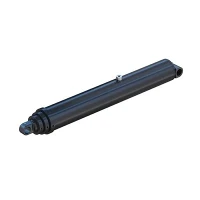
In the operational chain of sanitation vehicles and roll-off transport equipment, the quality of lifting and dumping actions often depends on a component that is easily overlooked yet bears the entire load: the multi-stage telescopic cylinder. The reciprocating push of garbage truck compaction mechanisms, the raising and tilting of roll-off hook arms, and the lifting and dumping of containers all share common characteristics: long stroke, heavy load, frequent action, and a clear requirement for control precision during retraction. Traditional single-acting cylinders rely on gravity or external force for retraction, making them inadequate for applications such as garbage trucks that require active control of retraction speed and position; while ordinary double-acting cylinders can drive in both directions, they struggle to balance long stroke with compact installation space. Shandong Yishui Zhongxin Machinery Co., Ltd. (Yishui Zhongxin Machinery) has focused on the manufacturing of multi-stage telescopic cylinders, welded cylinders, and custom hydraulic cylinders since 2008, with an annual production capacity of 300,000 units. Its double-acting telescopic cylinder is precisely a solution designed for the operating characteristics of garbage trucks and roll-off vehicles: using a multi-stage telescopic structure to achieve extra-long stroke within limited installation length, and a double-acting design to achieve active bidirectional control of extension and retraction, providing a reliable, controllable, and durable hydraulic power path for the lifting, dumping, and resetting actions of sanitation vehicles.
Structural Logic: How Multi-Stage Telescoping and Double-Acting Work Together
Understanding the engineering value of this product requires first clarifying the basic construction logic of multi-stage telescopic cylinders. The stroke of a single-stage cylinder is limited by the barrel length, and a direct linear constraint exists between installation space and working stroke. A multi-stage telescopic cylinder nests multiple barrels progressively, with the piston rod and barrels fitting together in sequence; in the fully retracted state, the total length is only that of the longest stage, while during extension the stages deploy in sequence, with total stroke reaching several times the retracted length. This structural characteristic is crucial for garbage trucks and roll-off vehicles: the installation space for lifting mechanisms and hook-arm mechanisms is usually strictly limited by the chassis, container, and compaction mechanism, while the required lifting stroke must be sufficient to raise the container to the dumping angle. The multi-stage telescopic structure is precisely the key to resolving this spatial contradiction.
The double-acting design adds a control dimension to this structure. Effective pressure area differences exist between the stages of a multi-stage telescopic cylinder, and the double-acting configuration introduces pressure oil on both sides of the piston, giving the cylinder active driving force in both extension and retraction directions. For garbage trucks, this characteristic is particularly critical in the reciprocating action of the compaction mechanism: the return stroke of the push plate or compaction head cannot rely solely on gravity or spring return but requires the hydraulic system to provide controllable retraction force to ensure stable action rhythm and precise positioning. For roll-off vehicles, the retraction action of the hook arm when lowering an empty container or resetting likewise requires active control, avoiding impact loads and structural damage caused by free fall under gravity. Zhongxin's double-acting telescopic cylinder, through its internal oil circuit design, enables each stage to obtain uniform hydraulic action during both extension and retraction, avoiding inter-stage sticking or sudden speed changes.
Manufacturing and Quality Control: From Certification Systems to 100% Pressure Testing
The reliability of hydraulic cylinders is built on manufacturing precision and seal integrity, and these two indicators are particularly critical under the high-frequency operating conditions of sanitation vehicles. Zhongxin Machinery has focused on cylinder manufacturing since 2008, employs more than 90 people, and has an annual capacity of 300,000 units. Its quality management system is certified to ISO 9001 and IATF 16949. As the quality management system standard for the automotive industry, the introduction of IATF 16949 means that Zhongxin has met the stringent requirements of the automotive supply chain in process control, traceability, and continuous improvement-a qualification guarantee of practical significance for cylinder products supporting garbage trucks and roll-off vehicles.
In terms of production processes, Zhongxin implements controlled machining, clean assembly, and 100% pressure testing before shipment. 100% pressure testing means that every cylinder undergoes seal integrity and pressure resistance verification at rated pressure before delivery, rather than batch sampling. For multi-stage telescopic cylinders, the integrity of inter-stage seals directly determines whether internal or external leakage will occur, and internal leakage under double-acting conditions will lead to loss of control over retraction speed and reduced lifting capacity. Zhongxin's investment in chrome plating processes-its Cambodia facility is installing chrome plating equipment-points to the corrosion resistance and wear resistance of the piston rod surface, a key process link for extending service life in sanitation vehicle cylinders that are chronically exposed to landfill leachate, rainwater, and road salt spray environments.
Application Adaptability: Differentiated Requirements of Garbage Trucks and Roll-Off Vehicles
The product demonstrates different adaptation priorities in its two main application scenarios. In garbage truck applications, the double-acting telescopic cylinder is mainly used for the push and reset of the compaction mechanism and the lifting and dumping of rear-loading garbage trucks. The high-frequency reciprocating action of the compaction mechanism places high demands on seal life and inter-stage wear resistance, while the double-acting design ensures active reset of the compaction head on the return stroke, freeing the compaction rhythm from gravitational constraints. In roll-off vehicle applications, the lifting and tilting actions of the hook arm involve heavy loads and long strokes, and the active retraction capability of the double-acting telescopic cylinder enables the hook arm to be smoothly and controllably lowered when placing an empty container or resetting, reducing impact on the chassis and hook-arm structure.
Zhongxin's OEM and engineering support capabilities further expand the product's adaptability. The company supports the complete process from drawing review and sample development to batch production, and can customize according to customers' mounting requirements, specification parameters, and private-label needs. This capability has practical value for sanitation vehicle manufacturers: different chassis models and container specifications have differentiated requirements for cylinder mounting distance, stroke, thrust, and retraction speed, and customization support enables the cylinder to precisely match the complete vehicle's hydraulic system rather than making do with selections from a standard range.
Conclusion
The engineering significance of the double-acting telescopic cylinder lies in its simultaneous resolution of two core contradictions in the hydraulic systems of sanitation vehicles: using a multi-stage telescopic structure to achieve extra-long stroke within compact installation space, and a double-acting design to turn the retraction process from passive waiting into active control. With manufacturing experience accumulated since 2008, an annual capacity of 300,000 units, dual ISO 9001 and IATF 16949 certification, and a 100% pressure testing factory standard, Zhongxin Machinery provides predictable quality assurance for this structural solution. When a garbage truck's compaction head smoothly returns after completing its push, or a roll-off vehicle's hook arm controllably resets when lowering an empty container, this telescopic cylinder has already fulfilled its most fundamental and critical mission in the sanitation operation chain: ensuring that every lift and every retraction falls exactly at the designed position and speed.