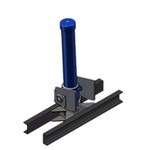
Telescopic cylinder, also known as multi-stage hydraulic cylinder, is a hydraulic cylinder with a multi-stage sleeve-shaped piston rod. Its main feature is that it can achieve a longer stroke by extending and retracting the multi-stage pistons one by one, and can be shortened when not working to save space.
Structure and working principle
Telescopic cylinder consists of two or more pistons, which are usually extended from large to small in sequence and retracted from small to large in sequence during the return stroke. This design allows the cylinder to be shortened when it does not need to work, saving space. The total stroke of the telescopic hydraulic cylinder is the sum of the sleeve strokes at each level, so the stroke can be quite long. When the load is constant, the working pressure of the hydraulic cylinder increases step by step. When it is extended step by step, the effective working area decreases step by step, resulting in a gradual increase in the extension speed and a gradual increase in the working pressure. Application scenarios Telescopic cylinders are widely used in situations that require long strokes and small space, such as telescopic arms of truck cranes, cleaning vehicles of dump trucks, and hydraulic supports of mining machinery. They are particularly suitable for situations where the installation space is limited and the stroke is required to be very long, such as telescopic arms of dump trucks and cranes.