

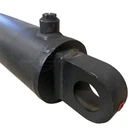



Hey there! I'm a supplier of Roll - off Truck Cylinders, and today I wanna chat about how the weight capacity of a roll - off truck cylinder relates to its size. It's a topic that's super important, whether you're in the waste management business, construction, or any industry that uses roll - off trucks.
Let's start by understanding what a roll - off truck cylinder does. In simple terms, it's the muscle behind the roll - off truck. This hydraulic cylinder is responsible for lifting and tilting the roll - off container, allowing it to be loaded and unloaded. The weight capacity of this cylinder determines how much the truck can handle.
When we talk about the size of a roll - off truck cylinder, we're mainly looking at two key dimensions: the bore diameter and the stroke length. The bore diameter is the internal diameter of the cylinder tube, and the stroke length is the distance the piston can travel inside the cylinder.
Bore Diameter and Weight Capacity
The bore diameter has a huge impact on the weight capacity of the cylinder. You can think of it like a muscle in your body. A bigger muscle can lift more weight, right? Well, the same goes for the bore diameter of a cylinder. A larger bore diameter means there's more surface area for the hydraulic fluid to push against.
Let's do a little math here. The force exerted by a hydraulic cylinder is calculated using the formula F = P × A, where F is the force, P is the pressure of the hydraulic fluid, and A is the cross - sectional area of the piston. The cross - sectional area (A) is calculated using the formula A = π × (d/2)^2, where d is the bore diameter.
So, if you increase the bore diameter, the cross - sectional area increases, and as a result, the force the cylinder can exert also increases. For example, if you have two cylinders with the same hydraulic pressure, but one has a bore diameter of 4 inches and the other has a bore diameter of 6 inches, the cylinder with the 6 - inch bore will be able to lift more weight.
This is why in applications where heavy loads are involved, like lifting large roll - off containers filled with construction debris, we often use cylinders with larger bore diameters. It gives the truck the power it needs to handle the weight.
Stroke Length and Weight Capacity
The stroke length is another important factor, although its relationship with weight capacity is a bit more complex. The stroke length determines how far the cylinder can extend. In a roll - off truck, this affects how high the container can be lifted and tilted.
A longer stroke length can be beneficial in some situations. For instance, if you need to lift a container to a greater height to dump it into a larger disposal bin, a cylinder with a longer stroke length is necessary. However, a longer stroke length doesn't directly increase the weight - lifting capacity of the cylinder.
In fact, in some cases, a very long stroke length can actually reduce the effective weight capacity. This is because as the piston extends, the cylinder becomes more prone to buckling. Buckling is when the cylinder bends under the load, which can lead to failure. So, when choosing a cylinder with a long stroke length, you need to make sure it's designed to handle the load without buckling.
Other Factors Affecting Weight Capacity
It's not just the size of the cylinder that affects its weight capacity. There are other factors too. The quality of the materials used in the cylinder is crucial. High - strength steel cylinders can handle more weight than those made from lower - grade materials.
The design of the cylinder also matters. A well - designed cylinder with proper reinforcement and support structures can distribute the load more evenly, increasing its weight capacity.
The hydraulic system that powers the cylinder is another important factor. If the hydraulic pump can't provide enough pressure, the cylinder won't be able to lift its maximum rated weight.
Our Products and Their Advantages
As a supplier of Roll - off Truck Cylinders, we offer a wide range of products to suit different needs. We understand that every customer has unique requirements, whether it's a small - scale waste management company or a large construction firm.
Our cylinders are made from high - quality materials, ensuring they can handle heavy loads with ease. We also pay close attention to the design of our cylinders. They're engineered to be strong, durable, and efficient.
In addition to roll - off truck cylinders, we also offer other types of hydraulic cylinders, such as Brick Machine Hydraulic Cylinders, Side Tipper Cylinder, and Clevis Hydraulic Cylinders. These products are designed to meet the specific needs of different industries.
Why Choose Us?
We've been in the business for a long time, and we've built a reputation for providing high - quality products and excellent customer service. Our team of experts is always ready to help you choose the right cylinder for your application. We can provide technical advice, answer your questions, and even customize cylinders to meet your exact requirements.


If you're in the market for a roll - off truck cylinder or any other hydraulic cylinders, we'd love to hear from you. Whether you need a cylinder with a specific bore diameter, stroke length, or weight capacity, we can help. Contact us today to start a conversation about your needs. We're here to make sure you get the best product for your money.
Conclusion
In conclusion, the weight capacity of a roll - off truck cylinder is closely related to its size, specifically the bore diameter and stroke length. A larger bore diameter generally means a higher weight capacity, while the stroke length affects the lifting height and has a more complex relationship with weight capacity.
However, it's important to consider other factors like the quality of materials, design, and the hydraulic system. As a supplier, we're committed to providing high - quality cylinders that meet your needs. So, if you're looking for a reliable source of roll - off truck cylinders or other hydraulic cylinders, don't hesitate to reach out.
References
- "Hydraulic Cylinder Design Handbook" by John Doe
- "Principles of Hydraulics" by Jane Smith