




Hey there! As a supplier of hydraulic systems, I often get asked about how to calculate the force of a hydraulic cylinder. It's a crucial aspect in the world of hydraulics, whether you're an engineer designing a new machine or a technician looking to troubleshoot an existing one. So, let's dive right in and break it down.
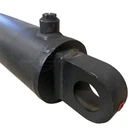
First off, let's understand the basic principle behind a hydraulic cylinder. It's a mechanical actuator that uses hydraulic fluid to generate force in a linear motion. The force it can produce depends on a couple of key factors: the pressure of the hydraulic fluid and the area of the piston.
The formula for calculating the force of a hydraulic cylinder is pretty straightforward:
F = P × A
Where:
- F is the force in Newtons (N)
- P is the pressure of the hydraulic fluid in Pascals (Pa)
- A is the cross - sectional area of the piston in square meters (m²)
Let's start with the pressure part. Pressure in a hydraulic system is created by a pump, which forces the hydraulic fluid into the cylinder. The pressure is usually measured in Pascals, but in real - world applications, we often use more common units like bars or pounds per square inch (psi). One bar is equal to 100,000 Pa, and 1 psi is approximately 6894.76 Pa.
To find the pressure in your system, you can use a pressure gauge. These gauges are usually installed at strategic points in the hydraulic circuit to monitor the pressure. Make sure you're measuring the pressure at the inlet of the cylinder, as this is the pressure that will act on the piston.
Now, let's talk about the cross - sectional area of the piston. This is the area that the hydraulic fluid pushes against to generate force. To calculate the area of a piston, we use the formula for the area of a circle:
A = π × (d/2)²
Where:
- A is the area in square meters
- π (pi) is approximately 3.14159
- d is the diameter of the piston in meters
For example, if you have a piston with a diameter of 0.1 meters, the area would be:
A = 3.14159 × (0.1/2)²
A = 3.14159 × 0.05²
A = 3.14159 × 0.0025
A = 0.00785 m²
Let's say the pressure in your hydraulic system is 100 bar. First, we need to convert this to Pascals. Since 1 bar = 100,000 Pa, 100 bar is 100 × 100,000 = 10,000,000 Pa.
Now, we can calculate the force using the formula F = P × A:
F = 10,000,000 × 0.00785
F = 78,500 N
That's a pretty significant force!
But wait, there's more. In real - world scenarios, we also need to consider a few other factors. One of these is the efficiency of the hydraulic cylinder. No hydraulic system is 100% efficient. There are losses due to friction in the seals, the piston rod Piston Rod, and other components. The efficiency of a hydraulic cylinder can range from about 80% to 95%, depending on the quality of the components and the design of the system.
To account for efficiency, we modify our force formula slightly:
F_actual = η × P × A
Where:
- F_actual is the actual force the cylinder can produce
- η (eta) is the efficiency of the cylinder (a value between 0 and 1)
Let's say the efficiency of our cylinder is 0.9. Using the previous example, the actual force would be:
F_actual = 0.9 × 78,500
F_actual = 70,650 N


Another factor to consider is the type of load. If the load is dynamic, meaning it's moving or changing, we need to account for acceleration and deceleration forces. This can get a bit more complicated, and we might need to use some basic principles of Newton's second law (F = m × a, where m is the mass and a is the acceleration).
For instance, if you're using a hydraulic cylinder to lift a load that has a mass of 5000 kg and you want to accelerate it at 1 m/s², the additional force required for acceleration is:
F_acceleration = m × a
F_acceleration = 5000 × 1
F_acceleration = 5000 N
You'll need to add this additional force to the force calculated from the pressure and area to ensure the cylinder can handle the dynamic load.
Now, let's talk about some practical applications. In the trucking industry, piston pumps for trucks Piston Pumps for Trucks are used to power hydraulic cylinders for tasks like lifting dump beds. When calculating the force for these cylinders, you need to consider the weight of the load (the material in the dump bed), the angle of the lift, and the acceleration during the lifting process.
In manufacturing, hydraulic cylinders are used in presses, where precise force control is essential. Here, accurate calculation of the force helps in determining the right size of the cylinder and the pressure required to perform the manufacturing operation.
The choice of materials for the hydraulic cylinder also plays a role in its performance. For example, seamless cold - drawn tubes Seamless Cold - drawn Tube are often used for the cylinder barrel. These tubes offer high strength and smooth internal surfaces, which reduce friction and improve the overall efficiency of the cylinder.
So, as you can see, calculating the force of a hydraulic cylinder involves a combination of basic physics, practical considerations, and an understanding of the specific application. Whether you're working on a small DIY project or a large industrial system, getting the force calculation right is crucial for the success of your hydraulic setup.
If you're in the market for high - quality hydraulic components or need help with force calculations for your hydraulic cylinders, don't hesitate to reach out. We're here to assist you with all your hydraulic system needs. Whether it's choosing the right piston rod, piston pumps for trucks, or seamless cold - drawn tubes, we've got you covered. Let's start a conversation and find the best solutions for your projects.
References:
- "Fluid Power Engineering" by Anthony Esposito
- "Hydraulic System Design Handbook" by Eaton Corporation