

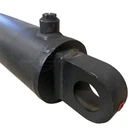

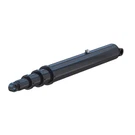


Hey there! As a supplier of Multistage Cylinders, I've had my fair share of experiences with these amazing pieces of machinery. Today, I'm gonna share with you how to control the movement of a multistage cylinder.
First off, let's understand what a multistage cylinder is. A multistage cylinder, also known as a telescopic cylinder, is a type of hydraulic cylinder that consists of a series of nested tubes, or stages. These cylinders are designed to provide a long stroke while maintaining a relatively compact retracted length. They're commonly used in applications where space is limited, such as dump trucks, forklifts, and other heavy machinery.
Now, let's get into the nitty - gritty of controlling its movement.
1. Understanding the Basics of Hydraulic Systems
Multistage cylinders operate based on hydraulic principles. Hydraulic systems use a incompressible fluid, usually oil, to transmit force from one point to another. When pressure is applied to the fluid in a hydraulic cylinder, it causes the piston to move, which in turn moves the cylinder rod.
To control the movement of a multistage cylinder, you need to have a good grasp of how hydraulic pumps, valves, and actuators work. The hydraulic pump is responsible for generating the pressure needed to move the fluid. Valves, on the other hand, control the flow and direction of the fluid. Actuators, like the multistage cylinder itself, convert the hydraulic energy into mechanical motion.
2. Controlling the Extension and Retraction
The extension and retraction of a multistage cylinder are mainly controlled by directional control valves. These valves determine the path of the hydraulic fluid, deciding whether it will enter the cylinder to extend it or exit the cylinder to retract it.
There are different types of directional control valves, such as spool valves and poppet valves. Spool valves are more common in hydraulic systems. They work by sliding a spool inside a valve body to open or close different ports, thus controlling the flow of fluid.
When you want to extend the multistage cylinder, the directional control valve is set to allow the hydraulic fluid to enter the base of the cylinder. As the fluid enters, it pushes the largest stage of the cylinder out first. Once the largest stage is fully extended, the pressure in the system builds up, and the next smaller stage starts to extend, and so on until all the stages are fully extended.
For retraction, the directional control valve is switched to allow the fluid to flow out of the cylinder. The smallest stage retracts first, followed by the next larger stage, until all the stages are fully retracted.
3. Controlling the Speed of Movement
The speed of the multistage cylinder's movement is determined by the flow rate of the hydraulic fluid. The flow rate can be controlled using flow control valves. These valves regulate the amount of fluid that enters or exits the cylinder per unit of time.
If you want the cylinder to move faster, you can increase the flow rate by adjusting the flow control valve. However, you need to be careful not to exceed the maximum flow rate that the cylinder can handle, as this can cause damage to the cylinder or other components in the hydraulic system.
Conversely, if you want the cylinder to move slower, you can decrease the flow rate. This is useful in applications where precise control of the movement is required, such as in some industrial automation processes.
4. Pressure Control
Pressure control is crucial when it comes to controlling the movement of a multistage cylinder. Excessive pressure can cause damage to the cylinder, while insufficient pressure may not be able to move the cylinder at all.
Pressure relief valves are used to protect the hydraulic system from over - pressure. These valves open when the pressure in the system exceeds a certain set value, allowing the excess fluid to flow back to the reservoir.
On the other hand, pressure reducing valves can be used to maintain a constant pressure in the part of the system where the multistage cylinder is located. This ensures that the cylinder operates under a stable pressure, which is important for smooth and reliable movement.
5. Special Considerations for Different Types of Multistage Cylinders
There are different types of multistage cylinders, such as Single Acting Telescopic Cylinders and Inverted Telescopic Cylinders.
Single acting telescopic cylinders are extended by hydraulic pressure but are retracted by external forces, such as gravity or a spring. When controlling a single acting telescopic cylinder, you need to ensure that there is enough external force available for retraction.
Inverted telescopic cylinders are designed with the smallest stage at the bottom and the largest stage at the top. The control principles are similar to regular multistage cylinders, but you may need to take into account the weight distribution and the potential for cavitation, especially when the cylinder is operating in an inverted position.


6. Feedback and Monitoring
To ensure precise control of the multistage cylinder's movement, it's a good idea to use sensors for feedback and monitoring. Position sensors can be used to determine the position of the cylinder at any given time. This information can be used to adjust the control parameters, such as the flow rate or pressure, to ensure that the cylinder reaches the desired position accurately.
Pressure sensors can also be used to monitor the pressure in the hydraulic system. If the pressure deviates from the normal range, it could indicate a problem, such as a leak in the system or a malfunctioning valve.
Conclusion
Controlling the movement of a multistage cylinder involves a combination of understanding hydraulic principles, using the right control valves, and monitoring the system. By having a good understanding of these aspects, you can ensure that your multistage cylinder operates smoothly, efficiently, and safely.
If you're in the market for high - quality Multistage Cylinders, we're here to help. We offer a wide range of multistage cylinders to meet your specific needs. Whether you need a single acting telescopic cylinder or an inverted telescopic cylinder, we've got you covered. Feel free to reach out to us for more information and to start a procurement discussion.
References
- "Hydraulic Systems: Fundamentals and Applications" by John Doe
- "Telescopic Cylinder Design and Operation" by Jane Smith