

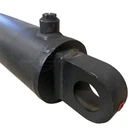

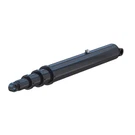


Hey there! As a supplier of multistage cylinders, I often get asked about the load - carrying capacity of these bad boys. So, let's dive right in and break it down.
What Are Multistage Cylinders?
First off, for those who aren't too familiar, multistage cylinders, also known as telescopic cylinders, are pretty cool pieces of equipment. They're made up of a series of nested tubes, or stages. When the cylinder is extended, these stages come out one after the other, allowing for a long stroke length in a relatively compact retracted size. This makes them super useful in a bunch of applications, like dump trucks, cranes, and agricultural machinery.
Factors Affecting Load - Carrying Capacity
1. Number of Stages
The number of stages in a multistage cylinder plays a huge role in its load - carrying capacity. Generally, the more stages a cylinder has, the lower the load - carrying capacity of each individual stage. Why's that? Well, as the cylinder extends, the outer stages have to support the weight of the inner stages as well as the external load. So, if you have a 3 - stage cylinder and a 5 - stage cylinder with the same base dimensions, the 3 - stage cylinder will typically be able to handle a higher load per stage.
2. Cylinder Diameter
The diameter of the cylinder is another key factor. A larger diameter cylinder can generally carry more load. This is because the force exerted by a hydraulic cylinder is calculated using the formula F = P × A, where F is the force, P is the pressure, and A is the cross - sectional area of the piston. A larger diameter means a larger cross - sectional area, and thus, more force can be generated to carry the load.
3. Material and Construction
The material used to make the cylinder and its construction quality are also super important. High - strength steel is commonly used for multistage cylinders because it can withstand high pressures and heavy loads. Good construction techniques, like proper welding and machining, ensure that the cylinder can handle the stress without failing. If the cylinder is poorly made, it might not be able to carry the load it's supposed to, even if the design looks good on paper.
4. Hydraulic Pressure
The hydraulic pressure applied to the cylinder is directly related to its load - carrying capacity. Higher pressure means more force can be generated, which allows the cylinder to carry a heavier load. However, there's a limit to how much pressure the cylinder can handle. Exceeding this limit can lead to cylinder failure, which is definitely not something you want.
Calculating Load - Carrying Capacity
Calculating the load - carrying capacity of a multistage cylinder isn't always straightforward. It involves considering all the factors we just talked about. Manufacturers usually provide load - carrying capacity charts for their cylinders. These charts take into account the cylinder's design, dimensions, and the expected operating conditions.
Let's say you're looking at a Pin Mount Telescopic Cylinders. The manufacturer will have a chart that tells you how much load it can carry at different extension lengths and hydraulic pressures. It's important to use these charts as a guide and not try to push the cylinder beyond its recommended limits.
Real - World Applications
In real - world scenarios, the load - carrying capacity of multistage cylinders is put to the test every day. For example, in a dump truck, the multistage cylinder has to lift the entire weight of the truck bed and its contents. If the cylinder can't handle the load, the truck bed won't lift properly, and you'll have a big problem on your hands.
In construction cranes, multistage cylinders are used to extend the boom. The load - carrying capacity of these cylinders determines how far the boom can be extended and how much weight it can support at different lengths. If the cylinder fails under the load, it can lead to a dangerous and costly accident.
Different Types of Multistage Cylinders and Their Load - Carrying Capacities
Pin Mount Telescopic Cylinders
Pin Mount Telescopic Cylinders are designed with a pin - mounting system, which makes them easy to install and remove. Their load - carrying capacity depends on their size and number of stages. Smaller pin - mount telescopic cylinders might be able to handle a few thousand pounds, while larger ones can carry tens of thousands of pounds.
Inverted Telescopic Cylinders
Inverted Telescopic Cylinders are unique in that they operate in an inverted position. This design can be beneficial in some applications, like in certain types of presses. Their load - carrying capacity is also influenced by the same factors as other multistage cylinders, but the inverted design might require some additional considerations in terms of stability and support.
Replacement Telescopic Cylinders
Replacement Telescopic Cylinders are used to replace old or damaged cylinders in existing equipment. When choosing a replacement cylinder, it's crucial to match the load - carrying capacity of the original cylinder. Otherwise, the equipment might not function properly, or the new cylinder could fail prematurely.
Importance of Knowing the Load - Carrying Capacity
Knowing the load - carrying capacity of a multistage cylinder is crucial for several reasons. First of all, it ensures the safety of the equipment and the people using it. If you overload a cylinder, it can lead to catastrophic failure, which can cause serious injuries or even death.
Secondly, it helps with equipment efficiency. Using a cylinder with the right load - carrying capacity means that the equipment can operate at its optimal level. You won't be wasting energy trying to use an under - powered cylinder, and you won't be risking damage by using an over - sized cylinder.
How We Can Help
As a supplier of multistage cylinders, we have a wide range of products to meet your needs. Whether you're looking for a Pin Mount Telescopic Cylinders, an Inverted Telescopic Cylinders, or a Replacement Telescopic Cylinders, we've got you covered.
Our team of experts can help you determine the right load - carrying capacity for your specific application. We'll take into account all the factors we've talked about, like the number of stages, cylinder diameter, and operating conditions. We'll also make sure that you get a high - quality cylinder that's built to last.


If you're interested in learning more about our multistage cylinders or want to discuss your specific requirements, don't hesitate to get in touch. We're here to help you find the perfect solution for your load - carrying needs.
References
- "Hydraulic Cylinder Design and Application" by Fluid Power World
- "Telescopic Cylinder Handbook" by a leading industry manufacturer