

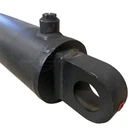



Hey there! As a supplier of hydraulic pistons, I've spent a good chunk of time diving deep into their world. Today, I wanna chat about the static characteristics of a hydraulic piston. It's gonna be a bit of a technical ride, but I'll do my best to keep it easy to follow.
Let's start with the basics. A hydraulic piston is a crucial component in a hydraulic system. It's the part that converts the hydraulic energy into mechanical force. When you think about it, it's like the muscle of the whole setup. It takes the pressure from the hydraulic fluid and uses it to move things around, whether it's a big industrial machine or a simple piece of equipment.
One of the key static characteristics of a hydraulic piston is its force output. This is basically how much pushing or pulling power it can generate. The force output of a hydraulic piston depends on a couple of things. First off, it's related to the pressure of the hydraulic fluid. The higher the pressure, the more force the piston can produce. You can think of it like blowing up a balloon. The more air (or in this case, hydraulic fluid) you pump in, the more pressure builds up, and the stronger the balloon pushes out.
Mathematically, the force output (F) of a hydraulic piston can be calculated using the formula F = P × A, where P is the pressure of the hydraulic fluid and A is the cross - sectional area of the piston. So, if you have a piston with a large cross - sectional area and high fluid pressure, you're gonna get a pretty hefty force output. This is super important in applications where you need to move heavy loads, like in construction equipment or manufacturing machinery.
Another important static characteristic is the piston's stroke length. The stroke length is the distance that the piston can travel from one end of its movement to the other. It's like the range of motion of your arm. A longer stroke length means the piston can move things over a greater distance.
The stroke length is determined by the design of the hydraulic cylinder that the piston is housed in. Cylinders come in different sizes and configurations, and the length of the cylinder barrel directly affects the stroke length of the piston. For example, in a Double Acting Hydraulic Cylinder, the piston can move in both directions, and the stroke length plays a crucial role in how far the attached equipment can be extended or retracted.


The diameter of the piston also has a significant impact on its static characteristics. A larger diameter piston can withstand higher pressures without deforming. It's like a thicker walled pipe can handle more water pressure without bursting. In addition to better pressure resistance, a larger diameter piston can also provide a more stable force output. This is because it has a larger surface area for the hydraulic fluid to act on, which distributes the force more evenly.
When it comes to the materials used in hydraulic pistons, that also affects their static characteristics. Most pistons are made from materials like steel or aluminum. Steel pistons are known for their high strength and durability. They can handle high pressures and heavy loads without wearing out quickly. Aluminum pistons, on the other hand, are lighter. This can be an advantage in applications where weight is a concern, like in some aerospace or automotive hydraulic systems.
The sealing of the piston is another aspect of its static characteristics. A good seal is essential to prevent hydraulic fluid from leaking out. If there's a leak, the pressure in the system drops, and the piston won't be able to generate the required force. Seals are usually made from rubber or other elastomeric materials. They need to be able to withstand the pressure of the hydraulic fluid, as well as any temperature and chemical conditions in the system.
Now, let's talk about some real - world applications. In a Roll - off Truck Cylinder, the hydraulic piston is responsible for lifting and dropping the roll - off containers. The force output and stroke length of the piston need to be carefully calibrated to ensure that the containers can be lifted smoothly and safely. If the force is too low, the container won't lift properly, and if the stroke length is too short, the container might not be able to be fully removed from the truck.
In a Side Tipper Cylinder, the piston is used to tilt the body of the truck to unload its cargo. Here, the static characteristics of the piston determine how quickly and smoothly the tilting action can occur. A piston with the right force output and stroke length can ensure that the truck can unload its cargo efficiently without any sudden jerks or instability.
As a hydraulic piston supplier, I know how important it is to get these static characteristics right. Every application has its own unique requirements, and we work closely with our customers to understand their needs. Whether it's a small - scale project or a large industrial operation, we can provide the right hydraulic pistons with the appropriate static characteristics.
If you're in the market for hydraulic pistons and need to understand more about how their static characteristics can benefit your specific application, don't hesitate to reach out. We're here to help you make the best choice for your project. We can offer advice on piston size, material, and other factors to ensure that you get the most out of your hydraulic system.
So, if you're looking to upgrade your equipment or start a new project that requires hydraulic pistons, let's have a chat. We can discuss your requirements in detail and find the perfect solution for you.
References
- "Hydraulic Systems Handbook" by John F. Dorgan
- "Fluid Power Technology" by David C. Ells